Capsule House vs. Modular Cabin: A Buyer’s Spec Comparison
Capsule House vs. Modular Cabin: A Buyer’s Spec Comparison
Resort and hospitality buyers frequently compare two prefabricated accommodation options: capsule houses and modular cabins. The terms are often used interchangeably, but they drive different site planning assumptions. A capsule house is a factory-built, compact, self-contained lodging pod, while a modular cabin is a broader category that can include room-size factory modules or on-site assembled cabins.
This article is a spec-level comparison. It uses three factory-built BOITO-MINGSU capsule house models — the M3, Apple Capsule MINI and the M8 — and shows what a buyer should verify before comparing them with a traditional modular cabin. The focus is on dimensions, floor area, weight, power, guest capacity, and site readiness.
Problem Definition: Why a Capsule and a Cabin Are Not Automatically Interchangeable
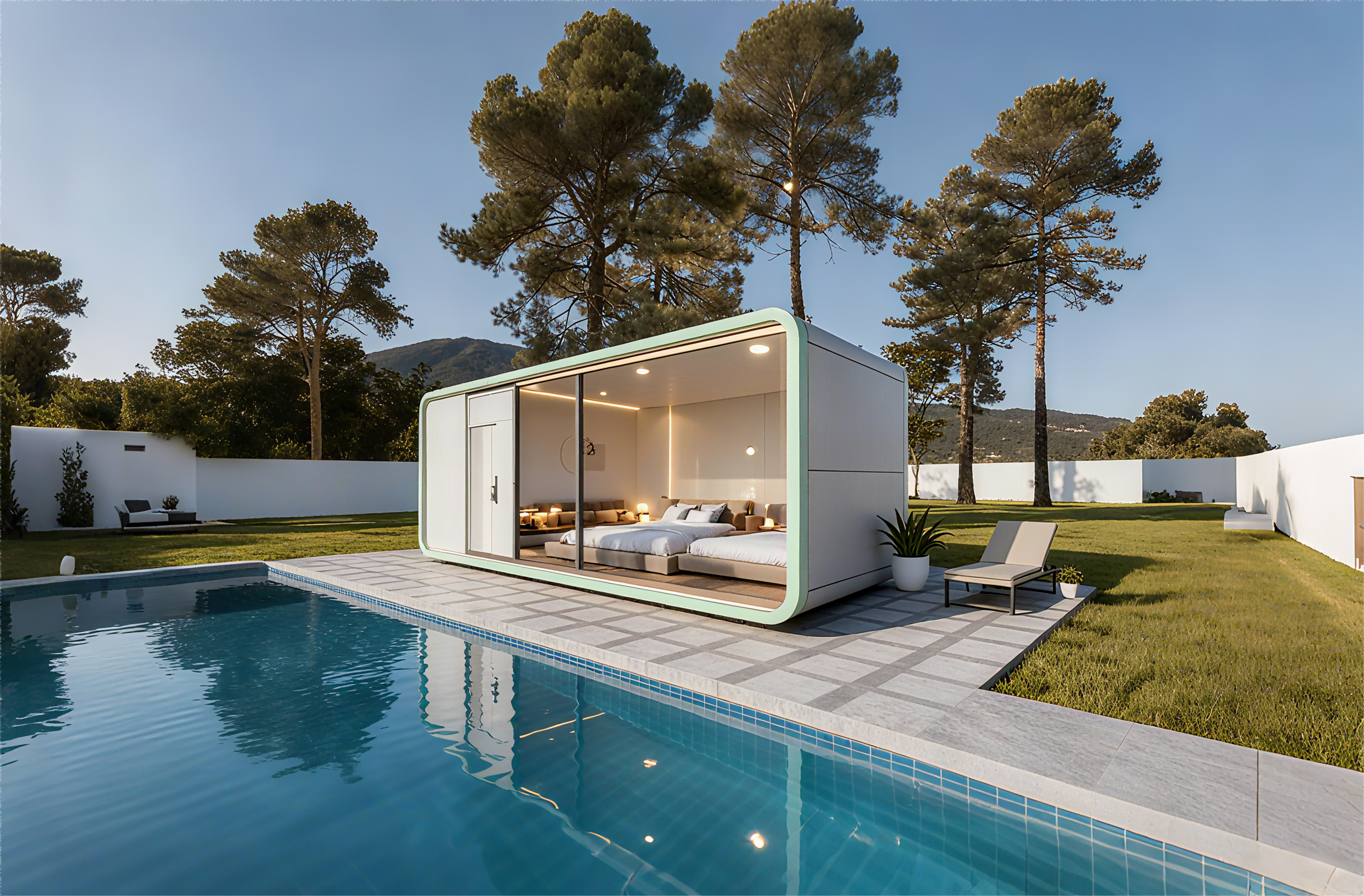
The real problem is not aesthetic style; it is specification mismatch. An 8.3-metre capsule house with a 3.3-metre width has a very different transport envelope, structural load, and electrical demand from a wider modular cabin built for permanent installation. Buyers who compare only price per square metre can miss foundation costs, cranage requirements, power connection costs, and relocation flexibility.
By the time the difference is discovered on site, the schedule and budget are already at risk. That is why the specification table below compares the capsule house side of the decision on hard numbers. For the modular cabin side, the buyer should request the same data points from each candidate supplier.
Industry Context: Prefabricated Lodging Demand Keeps Growing
The modular hospitality sector continues to expand. The global prefabricated housing market is projected to reach approximately USD 152.74 billion by 2026. Within nature-based lodging, glamping is a primary demand driver: the global glamping market is expected to reach about USD 7.9 billion by 2033, and cabins and pods already account for the largest accommodation segment with 43.0% of the glamping market in 2025.
These figures explain why developers are looking for products that combine visual distinctiveness with short installation times. Factory prefabrication also answers sustainability pressure: modular building reduces on-site waste by about 30% on average compared with site-built homes. For capsule house manufacturers, prefabrication is not an upgrade; it is the base production model.
Detailed Solution: Reference Specs from the BOITO-MINGSU Capsule House Line
Guangdong Mingsu Sojourn Technology Co., Ltd., a member of the BOITO Group, manufactures capsule houses and modular hospitality buildings under the BOITO-MINGSU brand. Its production range includes capsule houses, modular hotel units, glamping cabins, mobile sleep pods and modular villas. The factory is located in Guangdong, China, and has an annual output capacity of 1000 units.
The three models in this comparison are the M3, Apple Capsule MINI, and M8. All three are built on a hot-dip galvanized steel frame structure and are placed in the hospitality product category.
| Specification | M3 Breeze Single Capsule | Apple Capsule MINI | M8 Sleep Pod (Adventure) |
|---|---|---|---|
| Product type | Breeze Single Capsule | Apple Capsule | Sleep Pod (Adventure) |
| External dimensions (LxWxH) | 3m x 2.3m x 2.5m | 8.3m x 3.3m x 3.2m | 8.3m x 3.3m x 3.2m |
| Covered area | 6.9m² | 27.39m² | 27.39m² |
| Guest capacity | 1 person | 1–4 persons | 1–4 persons |
| Power consumption | 6KW | 7KW | 8KW |
| Total weight | ≈2T | ≈6.5T | ≈7T |
| Structural frame | Hot-dip galvanized steel frame | Hot-dip galvanized steel frame | Hot-dip galvanized steel frame |
The M3, known as the Breeze Single Capsule, is the smallest model. Its compact 6.9m² footprint and 2-ton weight make it suitable for satellite locations, steep terrain, or projects that need single-occupancy units. The M3 also has the lowest connected load at 6KW.
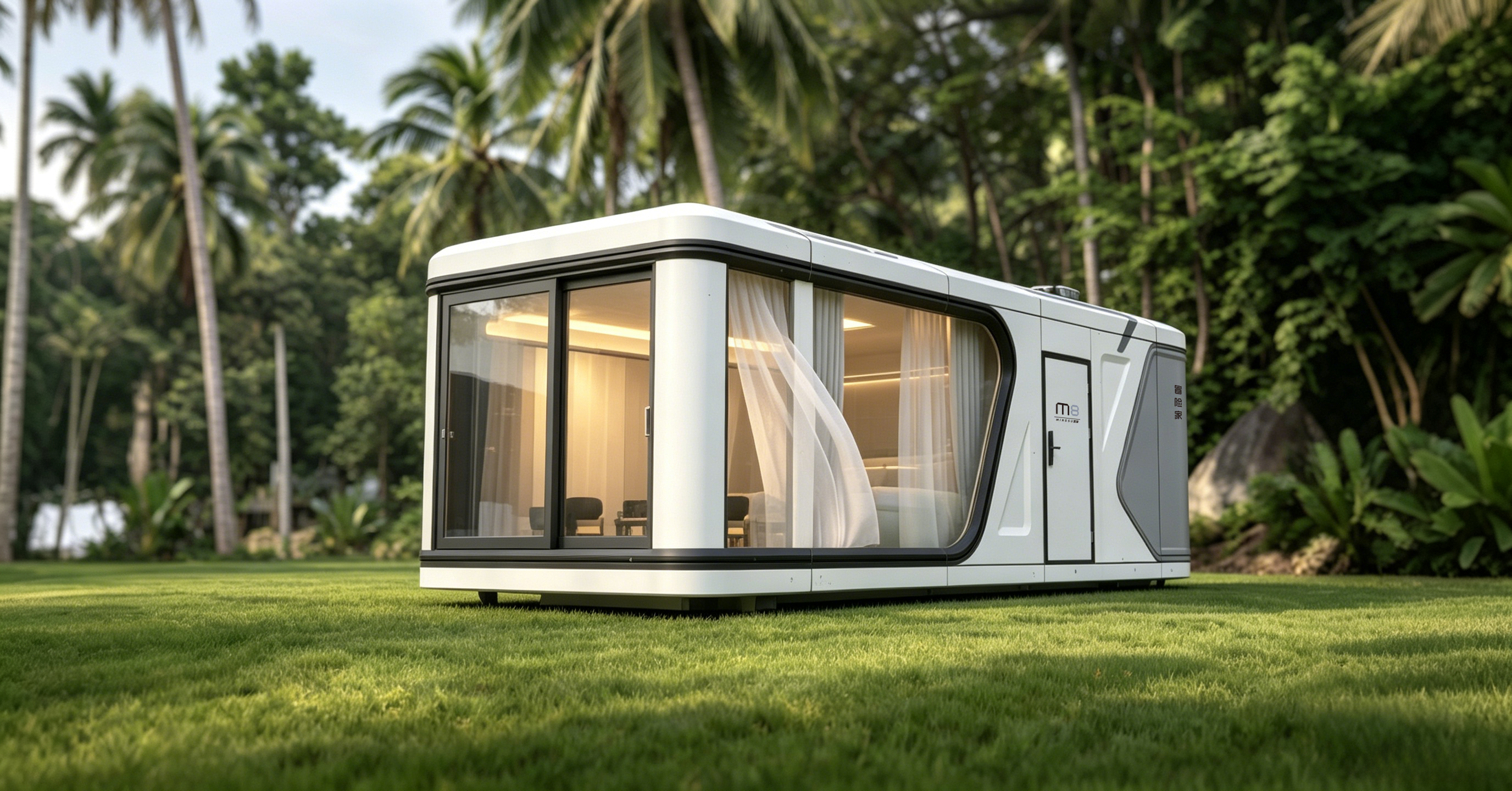
The Apple Capsule MINI provides a different value proposition. It measures 8.3m x 3.3m x 3.2m, gives 27.39m² of covered floor area, sleeps up to four guests, consumes 7KW and weighs about 6.5T. The Apple MINI shares the same external dimensions with the M8 but is lighter and has a lower rated power consumption.
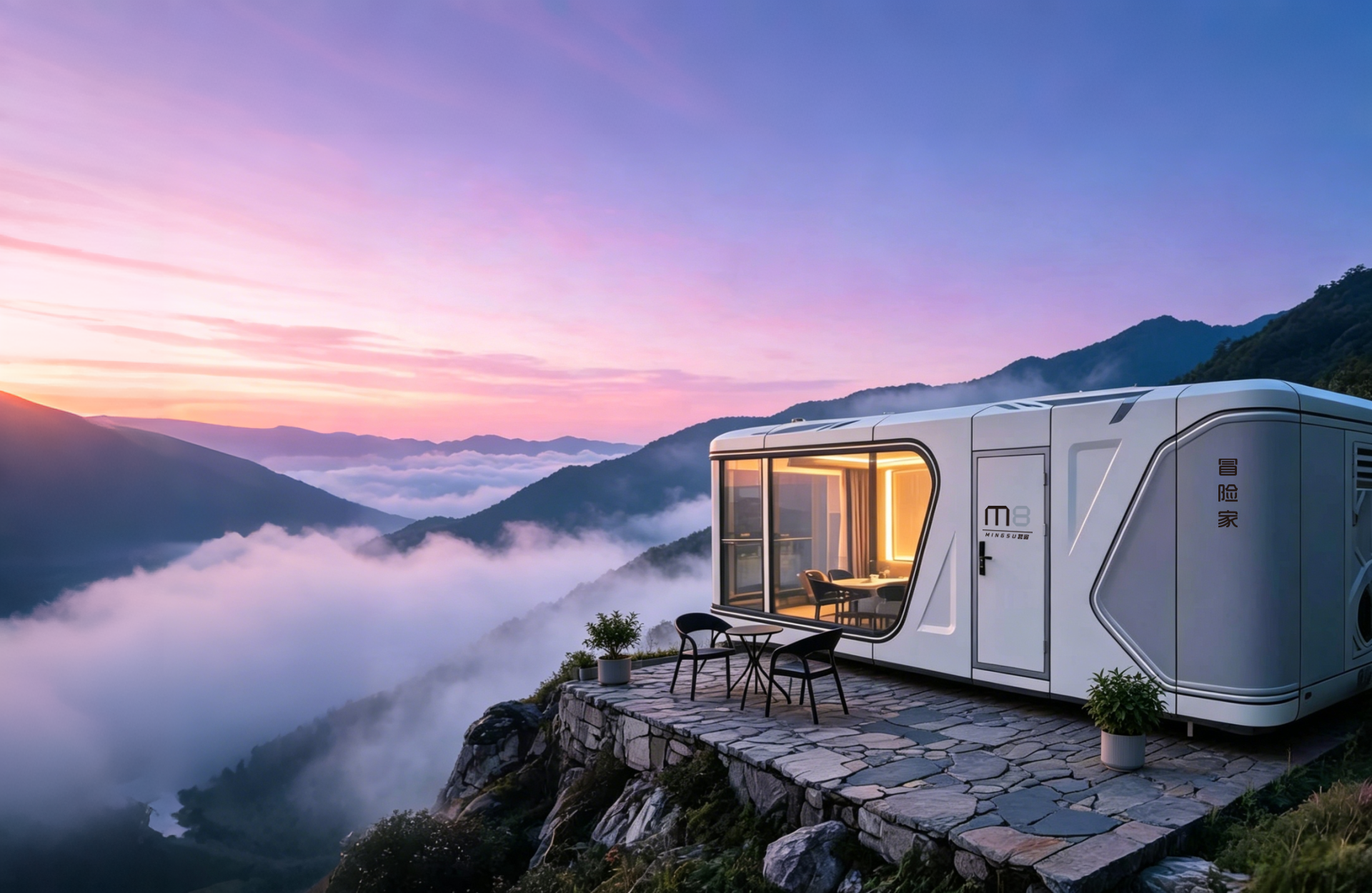
The M8 is categorized as a Sleep Pod (Adventure). It has the same length, width, height and floor area as the Apple MINI, but total weight increases to about 7T and power consumption to 8KW. This model is positioned for adventure-oriented accommodation and is included in the manufacturer’s Malaysia camping-resort track record, together with the M10 series.
Comparing Structural Assumptions: Capsule House vs. Modular Cabin
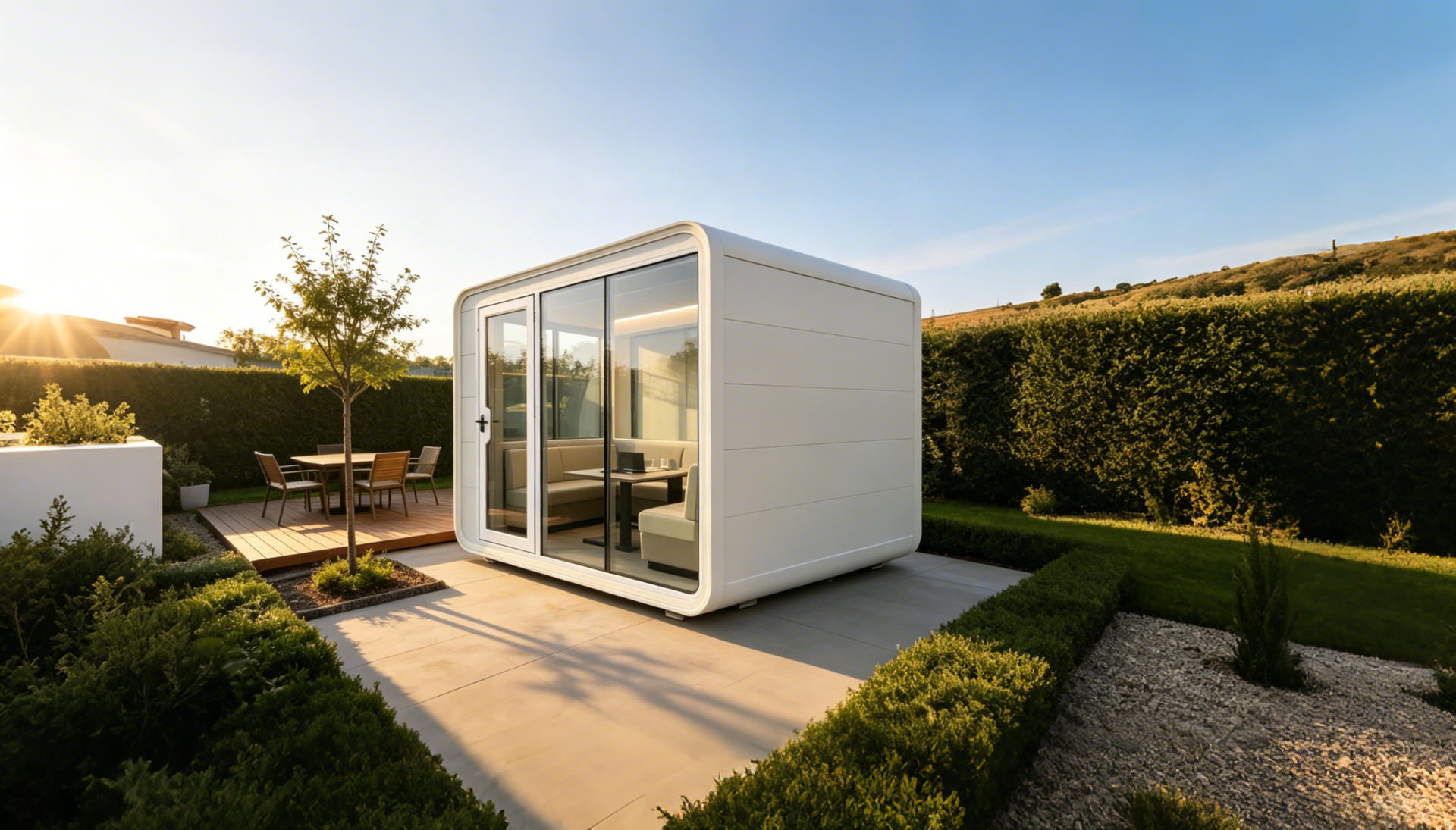
Capsule houses in this reference line use a hot-dip galvanized steel frame. That frame is important because hospitality projects are often located in coastal, forest, or mountain environments with high humidity, rain, and temperature swings. A galvanized steel structure offers a corrosion-resistant structural solution compared with some site-built timber frames, although the buyer should always check the exact fastener grade and coating specification from the modular cabin supplier.
The manufacturer also specifies supporting components in its application context: broken-bridge aluminum doors and windows, double-layer tempered Low-E hollow glass, exterior wall thermal insulation composite panels, and sound insulation materials. These details affect thermal performance and noise control — two factors that influence guest reviews in a capsule accommodation project.
Step-by-Step Breakdown: How to Evaluate Capsule vs. Cabin for a Site
- Define sleeping configuration. Count the actual number of guests per unit and decide whether they need separate rooms. M3 accommodates 1 person; Apple Capsule MINI and M8 accommodate 1–4 persons. If the brief requires two private bedrooms, a wider modular cabin may be worth considering.
- Map the footprint. Use covered area as a starting point: M3 covers 6.9m², Apple MINI and M8 cover 27.39m² each. Add deck, access path, fire separation, and unit spacing before comparing with a modular cabin’s total installed footprint.
- Check total weight and lifting route. M3 weighs about 2T, Apple Capsule MINI about 6.5T, and M8 about 7T. The heavier the unit, the more you need to confirm crane access, road width, turning radius, and ground bearing capacity.
- Verify electrical supply. M3 requires 6KW, Apple Capsule MINI 7KW, and M8 8KW. Ask the modular cabin supplier for its own rated electrical load, including HVAC and water-heating equipment, so the comparison is on the same basis.
- Compare site preparation and installation. The manufacturer’s modular capsule production model uses fully prefabricated construction. On site, no complex foundation is required — level the ground, then lift and place the unit. A single capsule placement can be completed in about 2 hours. The whole unit can be moved and reused when the project changes, and installation creates no on-site construction waste.
- Evaluate supplier capability before approving a vendor. BOITO-MINGSU provides ODM production services, supports customization of voltage and logo, has a monthly production capacity of 30 to 50 units, a standard MOQ of 10 units, and a lead time of 30–45 days. After-sales remote support is also available.
Use Cases: Where Capsule Houses Fit and Where a Modular Cabin May Be Better
The M3 works well for a one-guest scenario: a viewpoint sleep pod, a campground single unit, or a staff rest module. Its low power consumption and 2T weight reduce both site electrical work and lifting cost.
The Apple Capsule MINI suits a resort operator that wants a signature capsule silhouette and up to four guests per unit but has a constrained power budget or a site where saving 0.5T per unit makes a measurable logistics difference.
The M8 is the choice when the project can support 8KW per unit and needs an ‘adventure pod’ product series. In the manufacturer’s project record, a tourism resort OEM in Malaysia ordered 10 units for camping resorts, with the M8/M10 family used in that deployment. The reported operating outcome emphasizes stable operation and low noise.
On the other hand, a modular cabin may be more suitable if the project requires a permanent multi-room residence with full interior partitions, large kitchen facilities, or local building approval for a fixed ADU-style module. In that case, the buyer should ask for the same data set: module dimensions, foundation drawing, frame material, gross weight, power consumption, and relocation possibility.
Comparison Matrix: Capsule House Reference Data vs. Modular Cabin Verification Points
| Decision point | BOITO-MINGSU capsule house reference | Information to request from a modular-cabin supplier |
|---|---|---|
| Footprint | M3: 3m x 2.3m x 2.5m, 6.9m²; Apple MINI and M8: 8.3m x 3.3m x 3.2m, 27.39m² | Exact module outer dimensions, roof overhang, and required minimal spacing |
| Guest capacity | M3: 1 person; Apple MINI: 1–4 persons; M8: 1–4 persons | Bed configuration, room partitions, smoke/fire occupancy classification |
| Structure | Hot-dip galvanized steel frame | Frame material, coating system, insulation type, floor and wall layering |
| Weight | M3 ≈2T; Apple MINI ≈6.5T; M8 ≈7T | Total transport weight, axle load, cranage plan |
| Power | M3 6KW; Apple MINI 7KW; M8 8KW | Rated electrical load, HVAC type, water heater draw |
| Site installation | Level ground; lift and place; single-capsule placement about 2 hours; no complex foundation; ~80% civil cost savings; no on-site construction waste; movable and reusable | Foundation drawing, anchor method, utility trenching, assembly time, permanent vs. relocatable status |
FAQ
What is a capsule house?
A capsule house is a compact, factory-built, self-contained accommodation pod. The BOITO-MINGSU capsule line includes the M3 Breeze Single Capsule, Apple Capsule MINI and M8 Sleep Pod; these units are transported as complete shells and placed on prepared ground.
What is the difference between a capsule house and a modular cabin?
The main difference is product shape and installation logic. Capsule houses such as the M3, Apple MINI and M8 are narrow, elongated or pod-like modules designed for quick placement with minimal foundation work. A modular cabin is a broader category, usually room-like and often designed for more conventional foundation and assembly. Buyers should compare dimensions, weight, power, guest capacity, and site requirements rather than relying on category names.
How many people can stay in a BOITO-MINGSU capsule house?
The M3 is designed for 1 person. The Apple Capsule MINI and M8 both accommodate 1–4 persons. Guest capacity is a published spec and should be checked against the buyer’s actual bedding plan.
What power does each capsule model need?
The M3 has a power consumption of 6KW, the Apple Capsule MINI 7KW, and the M8 8KW. Site electrical design must be based on these numbers plus any external equipment installed by the operator.
Can BOITO-MINGSU customize capsule houses for a hospitality project?
Yes. BOITO-MINGSU operates as an ODM manufacturer, providing customization of voltage and logo. The factory’s monthly production capacity is 30 to 50 units, with a standard MOQ of 10 units and lead time of 30–45 days. After-sales remote support is available for troubleshooting and technical assistance.
Conclusion: Let the Specification Sheet Determine the Choice
Capsule houses and modular cabins will continue to appear in the same hospitality procurement discussions. But the right choice depends on measurable specifications — dimensions, covered area, weight, power, guest capacity, and site installation work. The BOITO-MINGSU M3, Apple Capsule MINI and M8 show how capsule-house specs can be translated into layout and logistics decisions.
Next step for resort buyers: build a simple load sheet using the specs above and compare it with each modular-cabin quote. For dimensions, floor plans, and the latest production line, download the BOITO-MINGSU 2026 brochure: BOITO-MINGSU brochure 2026. For project-specific questions, contact Yumi at info@gdmingsu.com, tel/WhatsApp +86-190 7530 9888, or visit www.boitohouse.com.
Have Questions or Need More Details?
Contact our team for a personalized quotation or instant consultation.
Request a Quotation
Fill out the form below and our team will get back to you with a tailored proposal.
WhatsApp Direct Chat
Prefer to chat in real-time? Message us on WhatsApp for instant assistance & quick answers.
- Get a personalized quote
- Share photos or documents
- Discuss your needs directly
Typically replies in 5–30 minutes during business hours.