Top Rated Capsule Houses for Boutique Resorts in 2026
Top Rated Capsule Houses for Boutique Resorts in 2026
Four factory-built capsule models cover almost every unit type a boutique resort needs in 2026: the M8 as the standard two-to-four-guest villa, the Apple Capsule MINI as a lower-load unit on the same footprint, the MS-XO8 F as the large-format food-and-beverage and reception cabin, and the M3 as a single-occupancy capsule for solo, wellness or overflow use. All four are manufactured by BOITO-MINGSU (Guangdong Mingsu Sojourn Technology Co., Ltd.) on a hot-dip galvanized steel frame structure with Low-E glazing systems.
Choosing between them is not a design preference exercise. On a boutique resort site, the model you select determines how many guests you can place, how much electrical capacity you must provision, what lifting equipment reaches the site, and whether the unit can double as revenue space for food and beverage or reception. This article ranks the four models against those criteria, using published per-model dimensions and documented project evidence, and explains how resort buyers should validate a manufacturer before committing a phase.
Why Model Selection Is the Real Risk in Capsule Resort Procurement
The expensive mistake in modular hospitality procurement is rarely the building itself. It is the mix. A boutique resort usually fixes a unit count first and a unit type second, then discovers that the chosen capsule does not match real occupancy, or that the electrical supply cannot carry the cluster, or that the heaviest unit cannot be lifted onto the intended terrace.
Traditional brick-and-concrete and light steel construction raise the stakes of that mistake. That route requires foundation construction, approval procedures and on-site building work, with a construction period that can run 3 to 6 months. The structure is also fixed in place: if the site is redeveloped or the business model changes, the building is scrapped and the investment is lost.
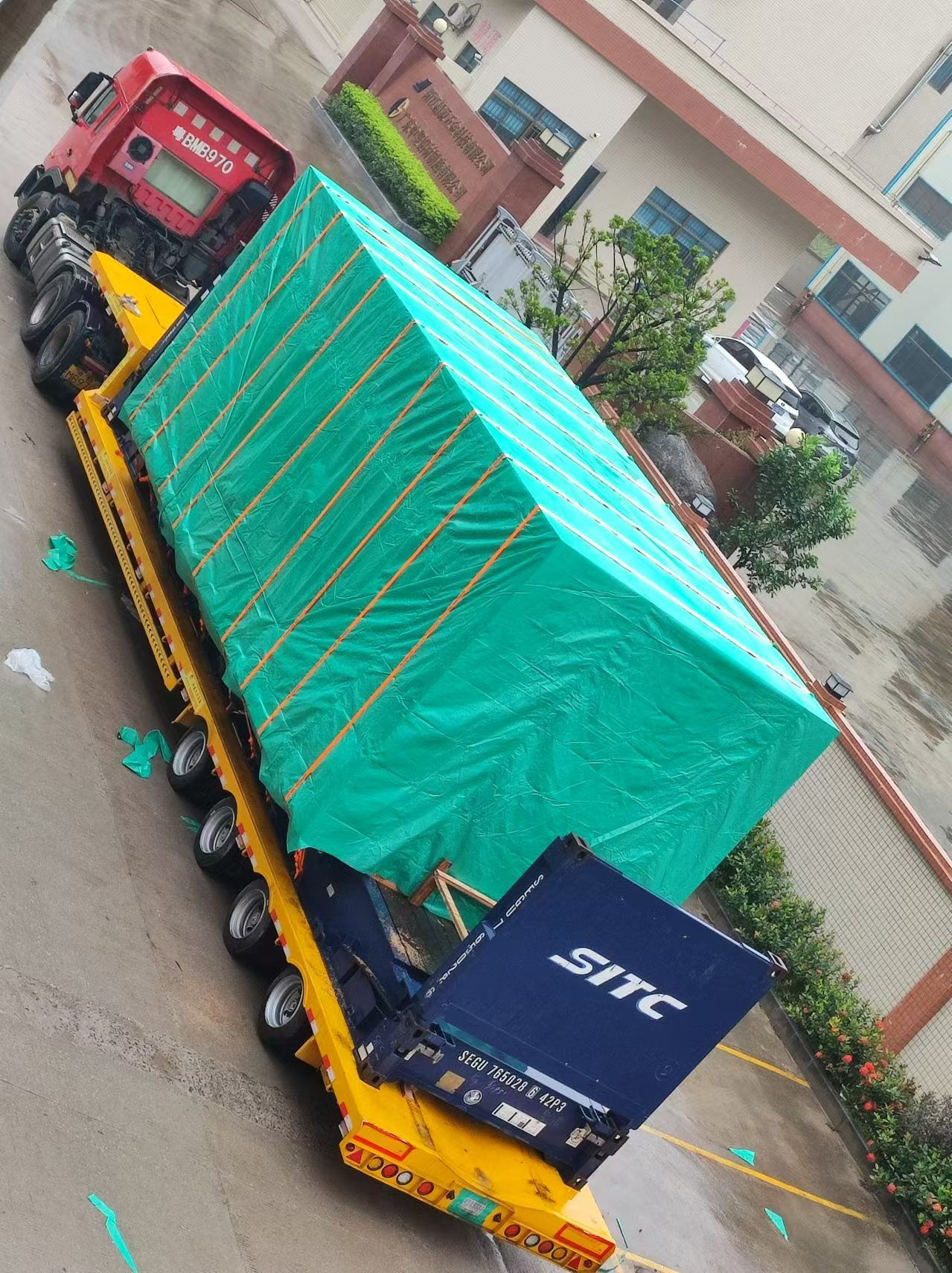
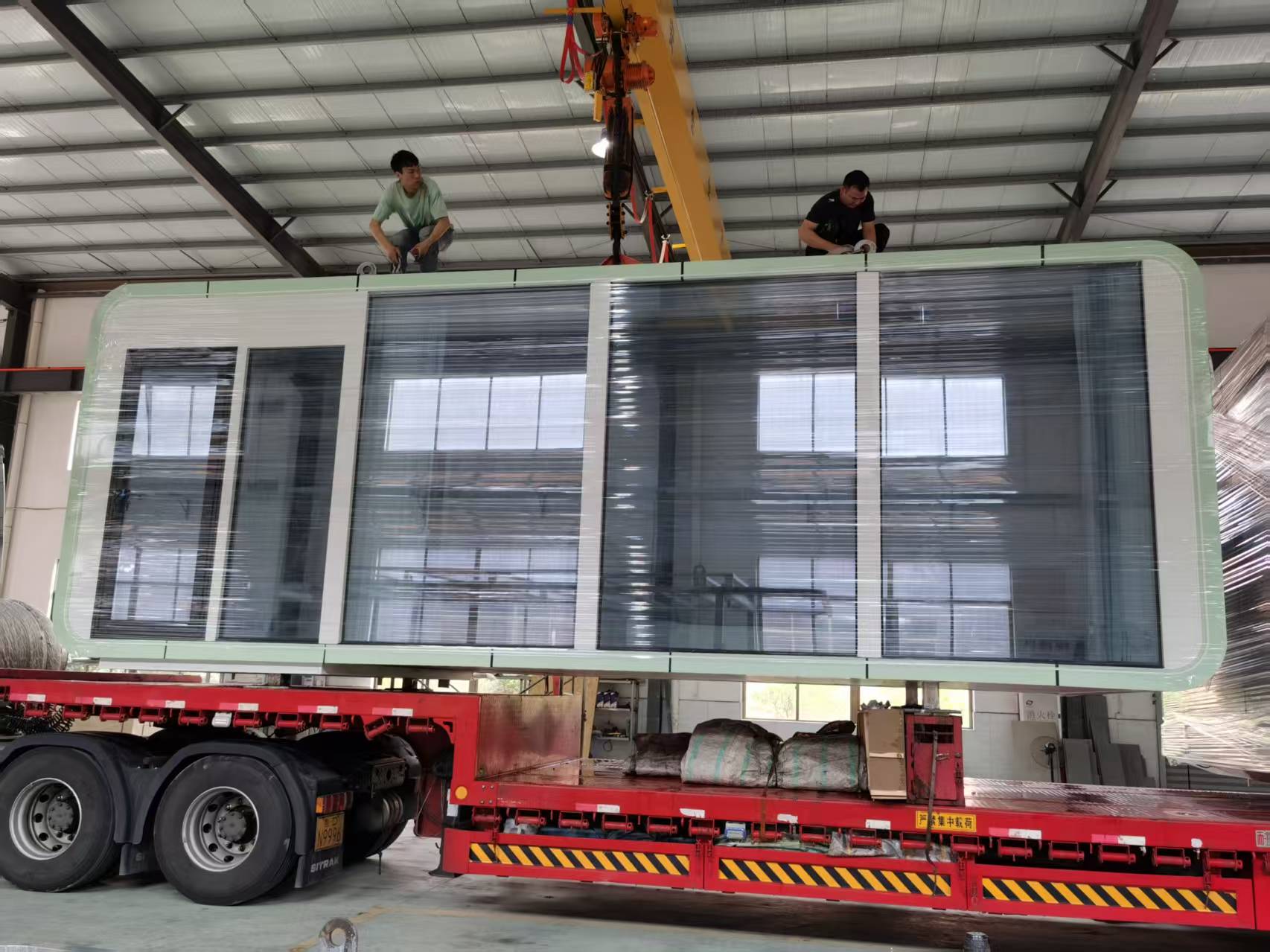
Modular space capsules follow a different model. Units are fully prefabricated in the factory, require no complex foundation on site, and can be lifted and placed onto levelled ground. According to the manufacturer's own comparison of brick-and-concrete versus modular space cabins, a single capsule placement can be completed in about 2 hours, on-site construction waste is eliminated, civil construction costs can be reduced by up to 80%, and the unit can be relocated and reused as a whole rather than written off.
Two technical variables decide whether that flexibility translates into guest satisfaction: the thermal envelope and the glazing system. In mountain, forest and coastal sites, where humidity, sun exposure and night-time temperature swings are constant, the specification of the insulation and glass is what separates a capsule that guests rebook from one that generates complaints.
Industry Background: Why Capsule Capacity Is Being Added Now
The demand side of this market is measurably expanding rather than speculative. Independent research puts the global prefabricated housing market at approximately USD 152.74 billion by 2026, with modular homes growing at an estimated CAGR of 7.05% through 2031 (Mordor Intelligence). Within hospitality specifically, the glamping segment that capsule cabins serve is expected to reach USD 7.9 billion by 2033 at a 9.5% CAGR, and cabins and pods already represent the largest accommodation segment in that market with a 43.0% share in 2025 (Grand View Research).
Guest demographics support the format as well. The 18–32 age group accounted for approximately 45.3% of the glamping and capsule stay consumer base in 2025 (IMARC Group), a cohort that books on visual differentiation and location rather than on conventional hotel-star cues. Asia-Pacific is the fastest-growing region for glamping and luxury modular pods, with a projected CAGR of 12.6% through 2034 (IMARC Group), while China's exports of prefabricated buildings under HS 9406 reached USD 3.24 billion in 2024, with Malaysia and the United States identified as key growth markets (OEC).
Supply-side conditions matter to buyers too. Modular construction can reduce construction timelines by 30%–50% compared with traditional on-site methods (Fortune Business Insights), and industry guides describe the Pearl River Delta as the dominant export cluster for capsule-style accommodation manufacturing. Buyers evaluating suppliers therefore frequently compare factories in the same geographic cluster, and the differentiating evidence becomes published model specifications, certifications and documented project records rather than geography alone.
Regulatory context is the other half of the background. In the EU, capsule houses fall under the Construction Products Regulation (CPR) and must carry CE marking for legal installation (European Commission). In the United States, capsule units are classified differently as RVs, ADUs or state-certified modular construction, and each classification requires a different foundation type. ISO 21542 and ISO 19650 are used to classify and manage data for volumetric modular (Type 3) and complete building (Type 4) units (BSI / ISO). None of these requirements disappear because a unit is prefabricated — they simply move earlier in the project timeline.
How This Ranking Was Built: Five Criteria That Matter for Hospitality Use
The models below are ranked within the BOITO-MINGSU capsule line, because it is the line covered by this review with published per-model dimensions, weights and power figures. Each model was assessed against five criteria that determine fit on a boutique resort site:
- Guest capacity per unit footprint. How many guests the unit actually sleeps per square metre of floor area, and whether that supports the resort's intended nightly rate band.
- Envelope and thermal performance. Frame system, wall insulation and glazing specification, because these drive guest comfort and operating cost in exposed outdoor climates.
- Electrical load per unit. Published power consumption per model, which sets the site's electrical provisioning and generator sizing.
- Transport and siting weight. Total unit weight, which determines crane selection, deck engineering and whether a unit can be placed on elevated terrain or restricted-access plots.
- Functional fit and documentation. Whether the unit is configured as a guest room, a commercial cabin or a single-occupancy pod, plus the compliance and certification evidence available for the destination market.
Price is deliberately not a ranking factor here. No verified price list was available for publication, and quoting unverified figures would be misleading in a procurement decision.
Detailed Solution: The Four Top-Rated Capsule Houses for Boutique Resorts
#1 — M8 Capsule House (Sleep Pod, Adventure Series)
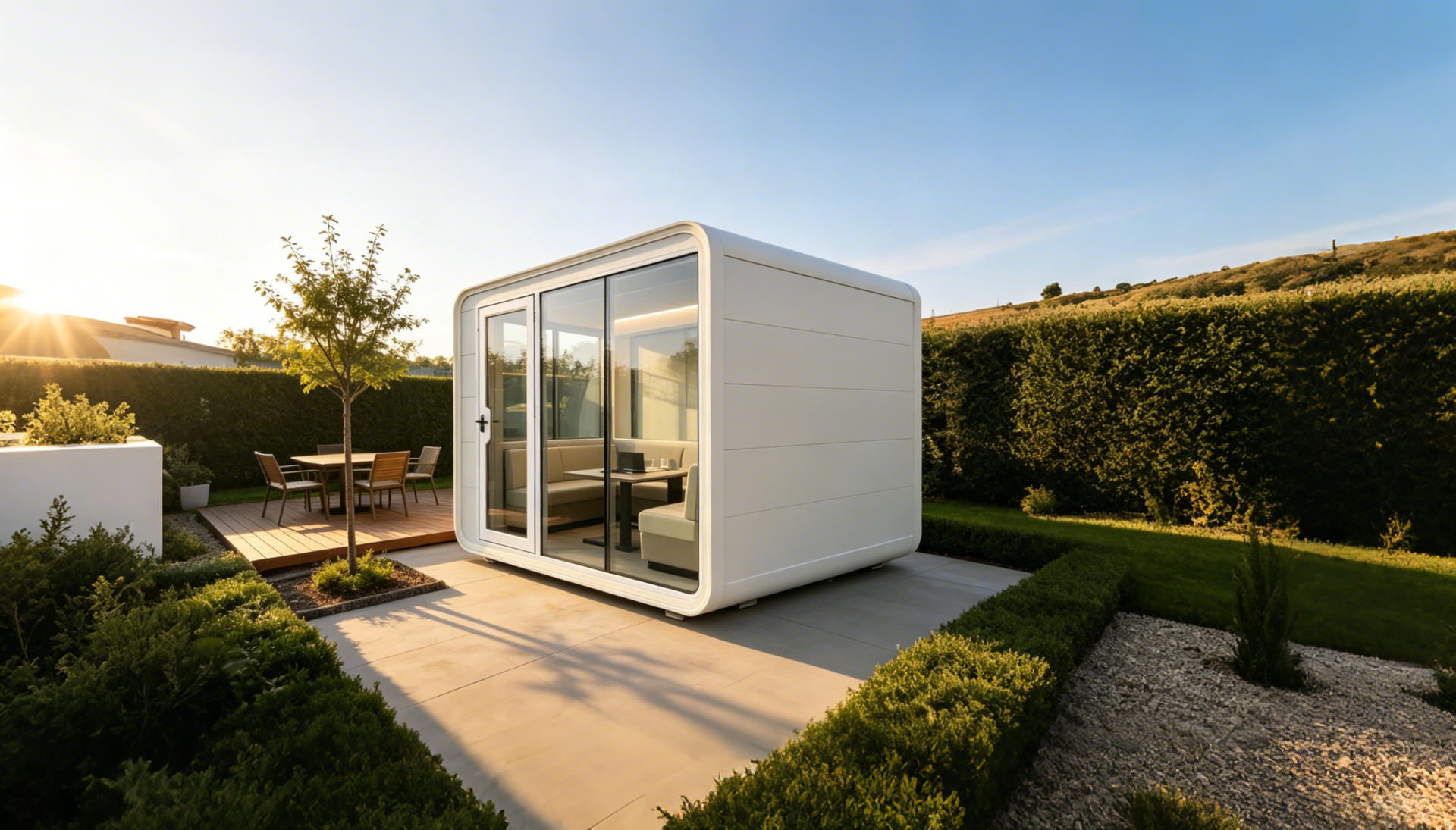
RANK 1 · PRIMARY GUEST VILLAThe M8 ranks first because it combines the most useful floor area in the range with a documented field record. Published specifications: 8.3 m × 3.3 m × 3.2 m, 27.39 m² of covered area, accommodation for 1 to 4 guests, 8 kW power consumption and a total weight of approximately 7 t, built on a hot-dip galvanized steel frame structure.
That combination — a 27.39 m² interior, up to four guests and roughly 7 t — is what makes the M8 the default guest villa on resort sites. It is heavy enough to feel solid and permanent to a guest, yet light enough to be lifted into forest, mountain or beach positions without a permanent foundation.
The project evidence is what separates it from a specification sheet. The M8 is the model associated with a tourism resort OEM installation in Malaysia, where 10 units were placed for camping resort accommodation. The documented case highlights low-noise operation, a hot-dip galvanized steel frame structure, and stable operation results. This is the reference to ask about when validating a capsule supplier for a resort-scale order.
#2 — Apple Capsule MINI (Apple Capsule Configuration)
RANK 2 · SAME FOOTPRINT, LOWER LOADThe Apple Capsule MINI is the closest alternative to the M8 and is intended for the hospitality industry. Published specifications: 8.3 m × 3.3 m × 3.2 m, 27.39 m² of covered area, accommodation for 1 to 4 guests, 7 kW power consumption and a total weight of approximately 6.5 t, on the same hot-dip galvanized steel frame structure.
Its practical value to a resort operator is arithmetic rather than aesthetic. The covered area and guest capacity are identical to the M8, so both models can share the same footing grid, the same deck design and the same furniture package. The differences are a 1 kW lower published power consumption and roughly 0.5 t less unit weight. On a site with a constrained electrical supply, or where units must be placed on elevated terraces, that margin matters across a cluster of ten or twenty units.
It ranks second rather than first for one reason: the published project record in this review is tied to the M8 configuration, so the Apple Capsule MINI should be validated through its own sample or pilot unit before a resort phases it in at scale.
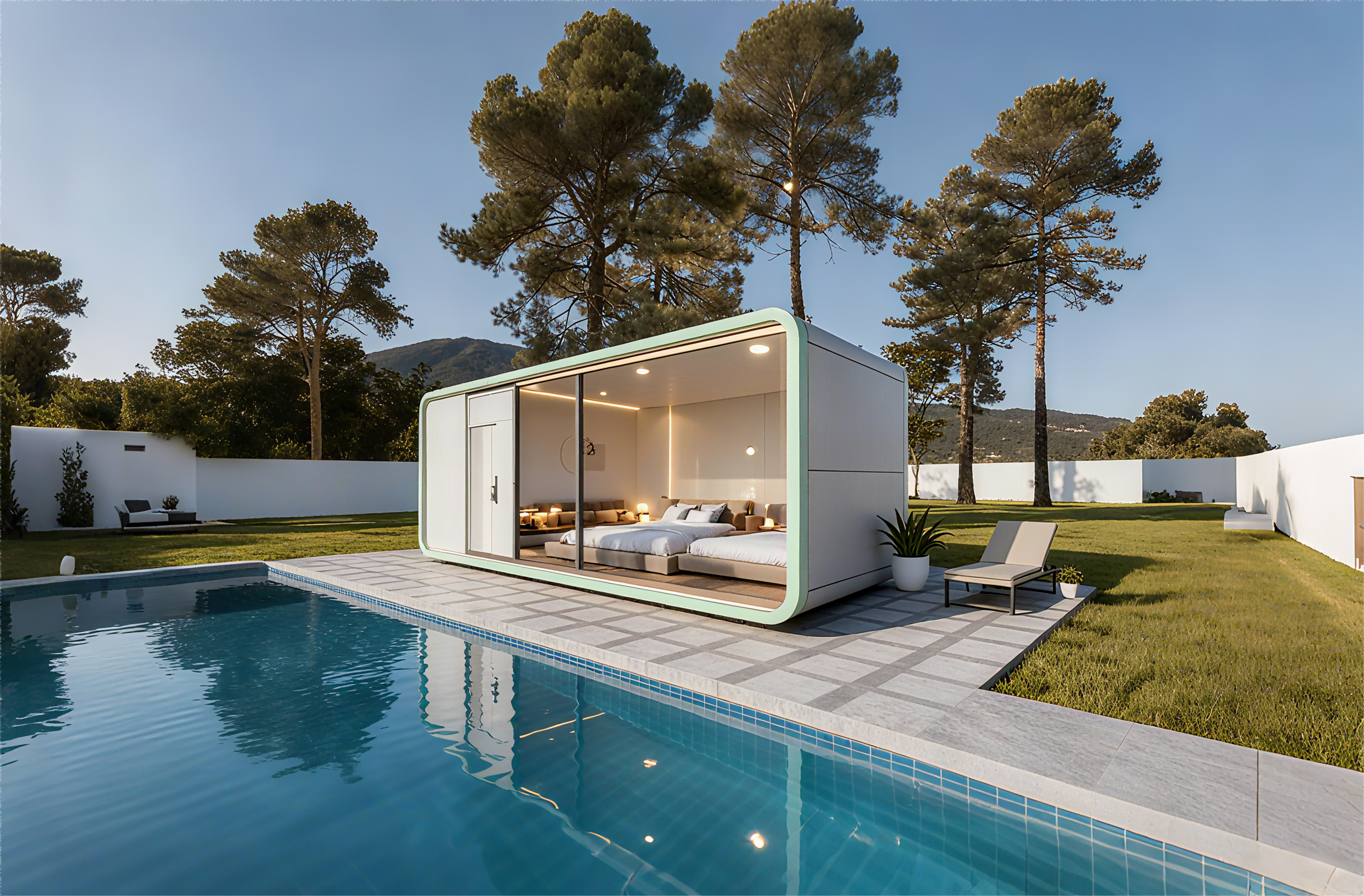
#3 — MS-XO8 F Commercial Cabin (Cafe Capsule)
RANK 3 · FOOD, BEVERAGE AND RECEPTIONThe MS-XO8 F is not a guest room, and ranking it third does not mean it is the least capable unit. It is the largest and most specialized model in this set, designed for catering service scenarios and the catering service industry. Published specifications: 16 m × 3.6 m × 3.2 m, 57.6 m² of covered area, 1 to 4 persons as the published guest figure, 10 kW power consumption and approximately 13 t of total weight, on a hot-dip galvanized steel frame with an anti-seismic steel structure system.
This is the model that carries the thermal and finish specification boutique resorts ask about most often. Its exterior wall is finished with fluorocarbon paint on a customized aluminium plate, and its insulation uses polyurethane foam with a thermal resistance of 3.2 m²K/W. Its glass and door-window system is double-layer tempered hollow Low-E glass, and the bathroom is equipped with Arrow sanitary appliances.
In a boutique resort master plan, that 57.6 m² envelope is the reception, breakfast pavilion, cafe or retail space that determines first impressions. At approximately 13 t, however, it requires deliberate logistics planning: heavier lifting capacity, firmer hardstanding and a more carefully positioned foundation pad than the guest-room models.
#4 — M3 Capsule House (Breeze Single Capsule)
RANK 4 · SINGLE-OCCUPANCY PODThe M3 is intended for the hospitality industry but operates at a different scale. Published specifications: 3 m × 2.3 m × 2.5 m, 6.9 m² of covered area, accommodation for 1 guest, 6 kW power consumption and approximately 2 t of total weight, on a hot-dip galvanized steel frame structure.
At roughly 2 t it is the lightest unit in the range, which gives it a role that the larger models cannot fill: placement on existing decks, terraces, rooftop areas or site pockets where crane access and load-bearing capacity are limited. Because it is the lowest-load unit at 6 kW, it is also the easiest to add to an existing electrical supply.
It ranks fourth only because it is a single-occupancy product, not a family or couple unit. Used correctly — solo glamping, wellness and treatment pods, overflow capacity at peak season, or staff accommodation — it raises the effective capacity of a site without new civil works.
Side-by-Side Specification Comparison
The table below consolidates the published figures for all four models. Every value is taken from the manufacturer's published model parameters; no estimated or interpolated figures are included.
| Criteria | M8 | Apple Capsule MINI | MS-XO8 F | M3 |
|---|---|---|---|---|
| Configuration | Sleep Pod (Adventure) | Apple Capsule | Commercial cabin (Cafe Capsule) | Breeze Single Capsule |
| Dimensions (L×W×H) | 8.3 m × 3.3 m × 3.2 m | 8.3 m × 3.3 m × 3.2 m | 16 m × 3.6 m × 3.2 m | 3 m × 2.3 m × 2.5 m |
| Covered area | 27.39 m² | 27.39 m² | 57.6 m² | 6.9 m² |
| Guests (published) | 1–4 persons | 1–4 persons | 1–4 persons | 1 person |
| Power consumption | 8 kW | 7 kW | 10 kW | 6 kW |
| Total weight | ≈7 t | ≈6.5 t | ≈13 t | ≈2 t |
| Frame structure | Hot-dip galvanized steel | Hot-dip galvanized steel | Hot-dip galvanized steel, anti-seismic system | Hot-dip galvanized steel |
| Industry designation | Hospitality | Hospitality | Catering service | Hospitality |
Envelope note: the documented envelope specification for the MS-XO8 F commercial cabin includes polyurethane foam insulation with a thermal resistance of 3.2 m²K/W and double-layer tempered hollow Low-E glass. The published equipment list for the capsule models covers a seismic hot-dip galvanized steel frame, broken-bridge aluminium doors and windows, double-layer tempered Low-E hollow glass, exterior wall thermal insulation composite panels and sound insulation materials.
Step-by-Step: From Site Brief to Installed Resort Unit
A boutique resort project follows six procurement stages. Each stage is where buyers should request specific evidence rather than accept general capability statements.
- Define the unit mix and the commercial target. Decide the split between two-to-four-guest villas (M8, Apple Capsule MINI), commercial space (MS-XO8 F) and single-occupancy pods (M3) before requesting quotations. The mix, not the unit price, drives project revenue.
- Match the model to the site. Confirm lifting access, hardstanding and deck load limits against unit weights of approximately 2 t, 6.5 t, 7 t and 13 t. This single check eliminates most installation surprises.
- Confirm the compliance path for the destination market. EU installations fall under the CPR and require CE marking; US installations are classified as RV, ADU or state-certified modular construction with corresponding foundation types. Confirm which path applies before design freeze.
- Prepare the ground. No complex foundation is required — levelled ground is the baseline, and a single capsule can be lifted and placed in approximately 2 hours according to the manufacturer's installation documentation. This is where the civil-cost and timeline advantage over traditional builds is realised.
- Order, customize and verify quality control. BOITO-MINGSU operates on an ODM model with voltage and logo customization, and its products can be customized to meet the building codes and electrical standards of different countries. Published commercial terms: MOQ of 10 units, monthly capacity of 30 to 50 units, lead time of 30–45 days, and 100% testing of units before shipment.
- Install, connect and maintain. Placement, utility connection and commissioning are followed by remote after-sales support. High-efficiency HVAC is part of the product configuration.
Certification and Compliance Evidence to Request
Compliance documentation is the fastest way to separate a producer from a trading intermediary. For the four models covered here, the relevant first-party evidence is an Environmental Management System Certificate to ISO 14001, certificate number ISC-E-2025-5371-R, issued by Beijing International Standard United Certification Co., Ltd. to the standard GB/T 24001-2016/ISO 14001:2015. It was issued on 24 November 2025 and expires on 23 November 2028, and its scope covers environmental management activities for the sites involved in the manufacturing of metal structures (mobile homes). The certification applies across the M3, Apple Capsule MINI, M8 and MS-XO8 F model range and is valid in global markets including the EU and Asia.
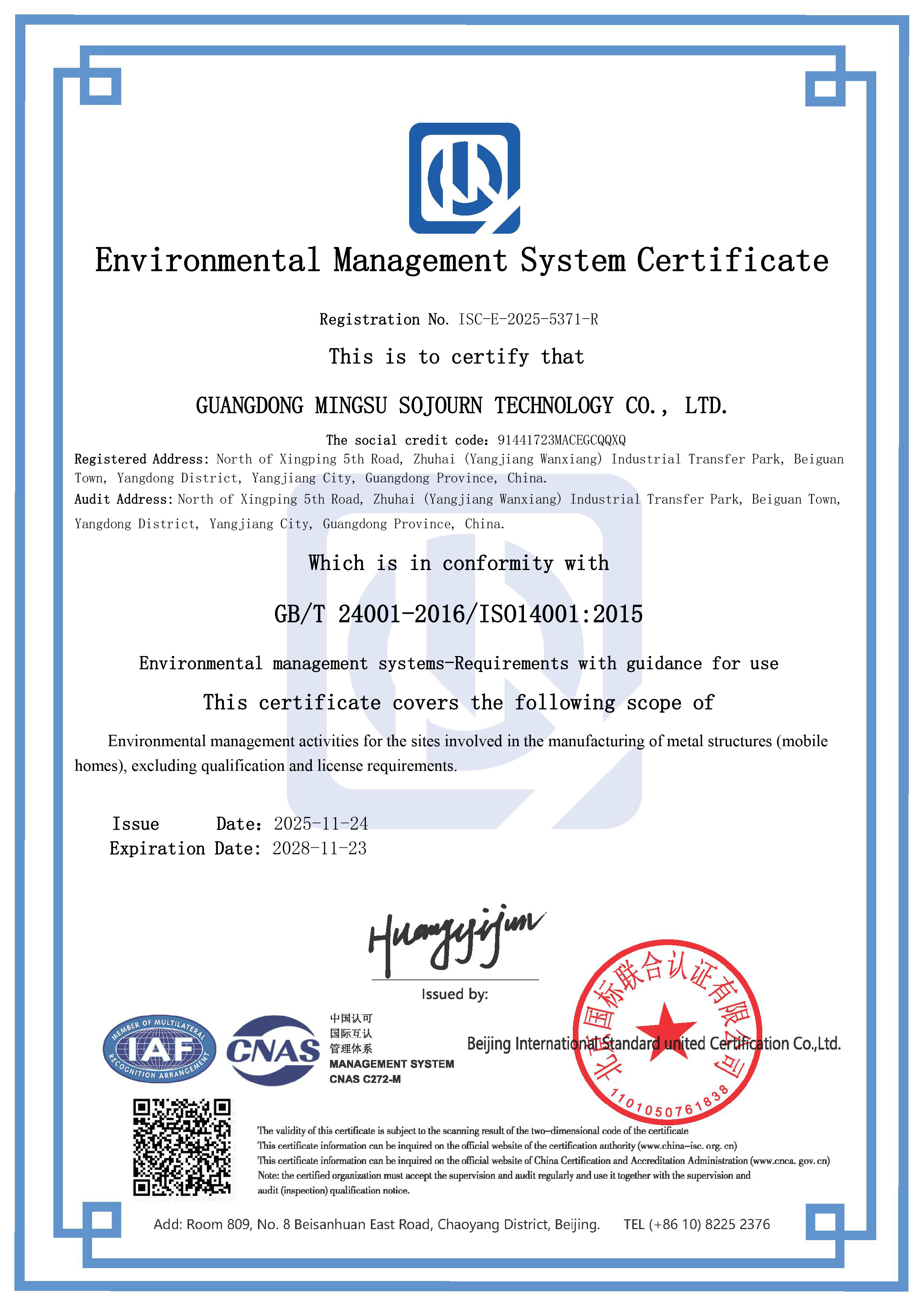
Certification is necessary but not sufficient. Confirm three things in writing: the certificate number and expiry date, the products and sites covered by its scope, and the destination-market declaration the supplier will provide (EU CE marking under the CPR, or the applicable US classification). Buyers who skip the second item frequently discover that a certificate covers a different facility or product family than the one being ordered.
Use Cases: Which Model Fits Which Hospitality Scenario
- Mountain, forest and lakeside boutique resorts: M8 as the primary guest villa, using its 27.39 m² and four-guest capacity to support premium nightly rates while remaining liftable onto terrain without permanent foundations.
- Power-constrained or elevated sites: Apple Capsule MINI, which delivers the same 27.39 m² and four-guest capacity at 7 kW and approximately 6.5 t, reducing electrical provisioning and deck load across a cluster.
- Food, beverage and arrival experience: MS-XO8 F, whose 57.6 m² footprint and catering-service designation make it suitable as a cafe, breakfast pavilion, reception or retail unit, supported by a polyurethane envelope at 3.2 m²K/W and double-layer tempered hollow Low-E glazing.
- Solo glamping, wellness pods, overflow and staff accommodation: M3, the approximately 2 t, 6.9 m² single-occupancy capsule that can be added to existing decks or tight site pockets at 6 kW.
- Real-world reference: a tourism resort OEM project in Malaysia installed 10 units for camping resort accommodation, with documented highlights of low-noise operation and stable operation results. This is the closest published analogue to a boutique resort phase-one order.
Frequently Asked Questions
Which capsule house models are recommended for a boutique resort project?
For a boutique resort, four models cover the full unit mix. The M8 (27.39 m², 1–4 guests, 8 kW, approximately 7 t) is the standard guest villa and has the strongest published project record. The Apple Capsule MINI covers the same 27.39 m² and four-guest capacity at 7 kW and approximately 6.5 t, making it the better choice where electrical supply or deck loading is constrained. The MS-XO8 F is the 57.6 m² catering-service cabin used for food and beverage, reception or retail. The M3 is the 6.9 m², single-guest, approximately 2 t capsule used for solo glamping, wellness, overflow or staff accommodation. All four use a hot-dip galvanized steel frame structure.
What certifications and compliance documents should a resort buyer verify before ordering capsule houses?
Verify two layers of documentation. The first is the manufacturer's first-party certification: BOITO-MINGSU holds an Environmental Management System Certificate to ISO 14001, certificate number ISC-E-2025-5371-R, issued by Beijing International Standard United Certification Co., Ltd. to GB/T 24001-2016/ISO 14001:2015, issued on 24 November 2025 and valid until 23 November 2028, covering the manufacturing sites for metal structures (mobile homes) and applicable to the M3, Apple Capsule MINI, M8 and MS-XO8 F models. The second is destination-market compliance: capsule houses installed in the EU fall under the Construction Products Regulation and require CE marking, while units in the United States are classified as RVs, ADUs or state-certified modular construction, each with different foundation requirements. ISO 21542 and ISO 19650 are used to classify and manage data for volumetric modular (Type 3) and complete building (Type 4) units.
How do you evaluate a capsule house manufacturer's ability to deliver a resort-scale order?
Test four published figures against your project schedule rather than relying on general capability claims. BOITO-MINGSU, a member of the BOITO Group founded in 2003, operates a 10,000 m² facility with 25 R&D engineers, an annual output of 1,000 units and a monthly capacity of 30 to 50 units. Its published commercial terms are a lead time of 30–45 days, an MOQ of 10 units, an ODM production mode with voltage and logo customization, and 100% testing of units before shipment. Export activity covers approximately 40% of output across Southeast Asia, the EU and the USA, with remote after-sales support. Ten units have been installed in Malaysia for a tourism resort OEM client, which is a useful capacity benchmark for a phased resort project.
What drives capsule house project cost beyond the unit price?
Five cost drivers sit outside the unit price. The first is the model mix itself: published power consumption ranges from 6 kW for the M3 to 10 kW for the MS-XO8 F, which determines electrical provisioning and generator sizing. The second is unit weight — approximately 2 t, 6.5 t, 7 t and 13 t across the range — which sets crane and hardstanding requirements. The third is envelope specification, including polyurethane insulation rated at 3.2 m²K/W and double-layer tempered hollow Low-E glass on the MS-XO8 F. The fourth is compliance documentation for the destination market. The fifth is the foundation: because modular capsules require no complex foundation and can be placed on levelled ground in roughly 2 hours, the manufacturer's comparison of brick-and-concrete versus modular space cabins cites civil construction cost reductions of up to 80%, alongside the ability to relocate and reuse the units instead of writing off fixed assets.
What is the typical lead time, and can a resort test a single unit before committing to a full phase?
The published lead time is 30–45 days with a monthly capacity of 30 to 50 units, and the MOQ is 10 units, so a resort should plan a pilot around that minimum order rather than a one-off single unit purchase. Testing is nevertheless practical: a single capsule can be lifted and placed in approximately 2 hours with no complex foundation, so a pilot cluster can be installed, operated and assessed on guest feedback before the remaining phases are released. For a boutique resort, the recommended sequence is to pilot the M8 as the guest villa and the Apple Capsule MINI as its lower-load equivalent, then add the MS-XO8 F for food and beverage and the M3 for single-occupancy capacity. To review full model specifications, download the BOITO-MINGSU 2026 product brochure, or send your project brief to info@gdmingsu.com.
Conclusion: Match the Model to the Business Case, Then Validate It
For boutique resorts in 2026, the four top-rated capsule models split cleanly along function rather than quality. The M8 is the proven guest villa: 27.39 m², 1–4 guests, 8 kW, approximately 7 t, with a documented 10-unit tourism resort installation in Malaysia. The Apple Capsule MINI delivers the identical footprint and guest capacity at 7 kW and approximately 6.5 t for sites where power and deck loading are the constraint. The MS-XO8 F is the commercial engine of a resort — 57.6 m² of catering-service space with polyurethane insulation at 3.2 m²K/W and double-layer tempered hollow Low-E glazing. The M3 is the flexible, approximately 2 t single-occupancy unit that adds capacity without new civil works.
The procurement logic that follows is straightforward. Define the unit mix first, check each model's weight and power figures against the actual site, confirm the compliance route for the destination market, and require the certificate number, scope and testing regime in writing before releasing a phase. A manufacturer that can supply an ISO 14001 certificate with a verifiable number, 100% pre-shipment testing, a 30–45 day lead time and a documented resort reference gives a buyer something more useful than a catalogue — a project that can be phased, financed and relocated.
Planning a boutique resort phase? BOITO-MINGSU manufactures capsule houses, modular hotel units, glamping cabins, mobile sleep pods and modular villas at its 10,000 m² facility in Guangdong, China, exporting to Southeast Asia, the EU and the USA.
Website: www.boitohouse.com · Email: info@gdmingsu.com · Tel / WhatsApp: +86-190 7530 9888 · Contact: YUMI
Have Questions or Need More Details?
Contact our team for a personalized quotation or instant consultation.
Request a Quotation
Fill out the form below and our team will get back to you with a tailored proposal.
WhatsApp Direct Chat
Prefer to chat in real-time? Message us on WhatsApp for instant assistance & quick answers.
- Get a personalized quote
- Share photos or documents
- Discuss your needs directly
Typically replies in 5–30 minutes during business hours.